| Availability: | |
|---|---|
| Quantity: | |
K-600-1
Application

The reciprocating feeder is suitable for the feeding of coal, slag or other loose granular materials with small grinding properties and small viscosity. This conveying equipment is widely used in crushing and screening production lines in industries such as mines, gravel yards, building materials and coal mines.

Principle

When the motor is started, the inclined bottom plate is dragged by the coupling, reducer and crank linkage mechanism to make linear reciprocating motion on the carrier roller, and the material is evenly unloaded onto the conveyor or other screening equipment.
Feature

Adopt the principle of near-resonance, low energy consumption.
The material exhibits a micro-throwing motion within the trough, resulting in minimal wear.
Both plate and though frame are double-layer structure, adjustable and replaceable.
Large conveying capacity and multi-gear adjustment in feeding amount.
The drive units are symmetrically arranged and equipped with dual push rods, ensuring balanced force distribution and stable power transmission.
Structure

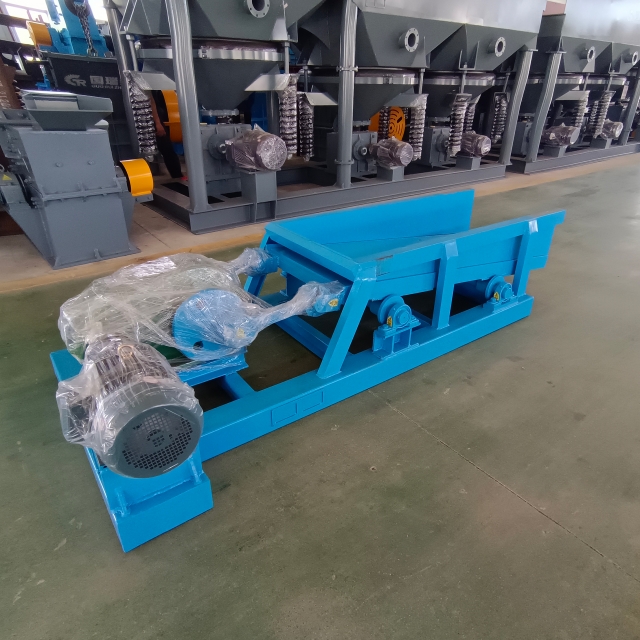
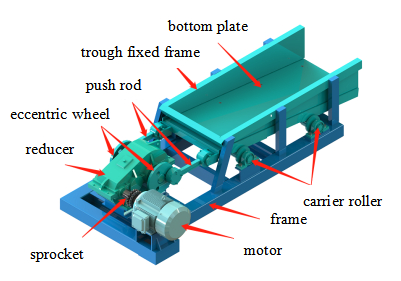
RUIJIE reciprocating feeder consists of a motor, reducer, sprocket, eccentric wheel, push rod, feeding trough, carrier rollers, and frame. Powered by the motor, the eccentric mechanism drives the trough to reciprocate, achieving continuous and uniform material feeding.

Technical Parameter

Model | Trough Width (mm) | Stroke | Processing Capacity (t/h) | Power(kw) | Dimensions (L*W*H) (mm) | Weight(kg) |
K-600 | 600 | 160~200 | 40-70 | 7.5 | 3070*1305*580 | 1070 |
Trough width can be customized. | ||||||
Instructions

Reciprocating feeders can be installed either ground-mounted or suspended beneath the hopper discharge outlet. Prior to feeder operation, the material hopper must maintain a sufficient inventory level to prevent direct impact on the pallet during material loading.
Applied in the IBA Production Line

Ruijie vibrating feeder is usually installed at the beginning of sorting line to feed materials uniformly to crushers, screens, and other processing equipment.


Application

The reciprocating feeder is suitable for the feeding of coal, slag or other loose granular materials with small grinding properties and small viscosity. This conveying equipment is widely used in crushing and screening production lines in industries such as mines, gravel yards, building materials and coal mines.

Principle

When the motor is started, the inclined bottom plate is dragged by the coupling, reducer and crank linkage mechanism to make linear reciprocating motion on the carrier roller, and the material is evenly unloaded onto the conveyor or other screening equipment.
Feature

Adopt the principle of near-resonance, low energy consumption.
The material exhibits a micro-throwing motion within the trough, resulting in minimal wear.
Both plate and though frame are double-layer structure, adjustable and replaceable.
Large conveying capacity and multi-gear adjustment in feeding amount.
The drive units are symmetrically arranged and equipped with dual push rods, ensuring balanced force distribution and stable power transmission.
Structure

RUIJIE reciprocating feeder consists of a motor, reducer, sprocket, eccentric wheel, push rod, feeding trough, carrier rollers, and frame. Powered by the motor, the eccentric mechanism drives the trough to reciprocate, achieving continuous and uniform material feeding.

Technical Parameter

Model | Trough Width (mm) | Stroke | Processing Capacity (t/h) | Power(kw) | Dimensions (L*W*H) (mm) | Weight(kg) |
K-600 | 600 | 160~200 | 40-70 | 7.5 | 3070*1305*580 | 1070 |
Trough width can be customized. | ||||||
Instructions

Reciprocating feeders can be installed either ground-mounted or suspended beneath the hopper discharge outlet. Prior to feeder operation, the material hopper must maintain a sufficient inventory level to prevent direct impact on the pallet during material loading.
Applied in the IBA Production Line

Ruijie vibrating feeder is usually installed at the beginning of sorting line to feed materials uniformly to crushers, screens, and other processing equipment.